
See where you are at so you can understand where you are going
SpecKit Monitor - See where every feature really stands
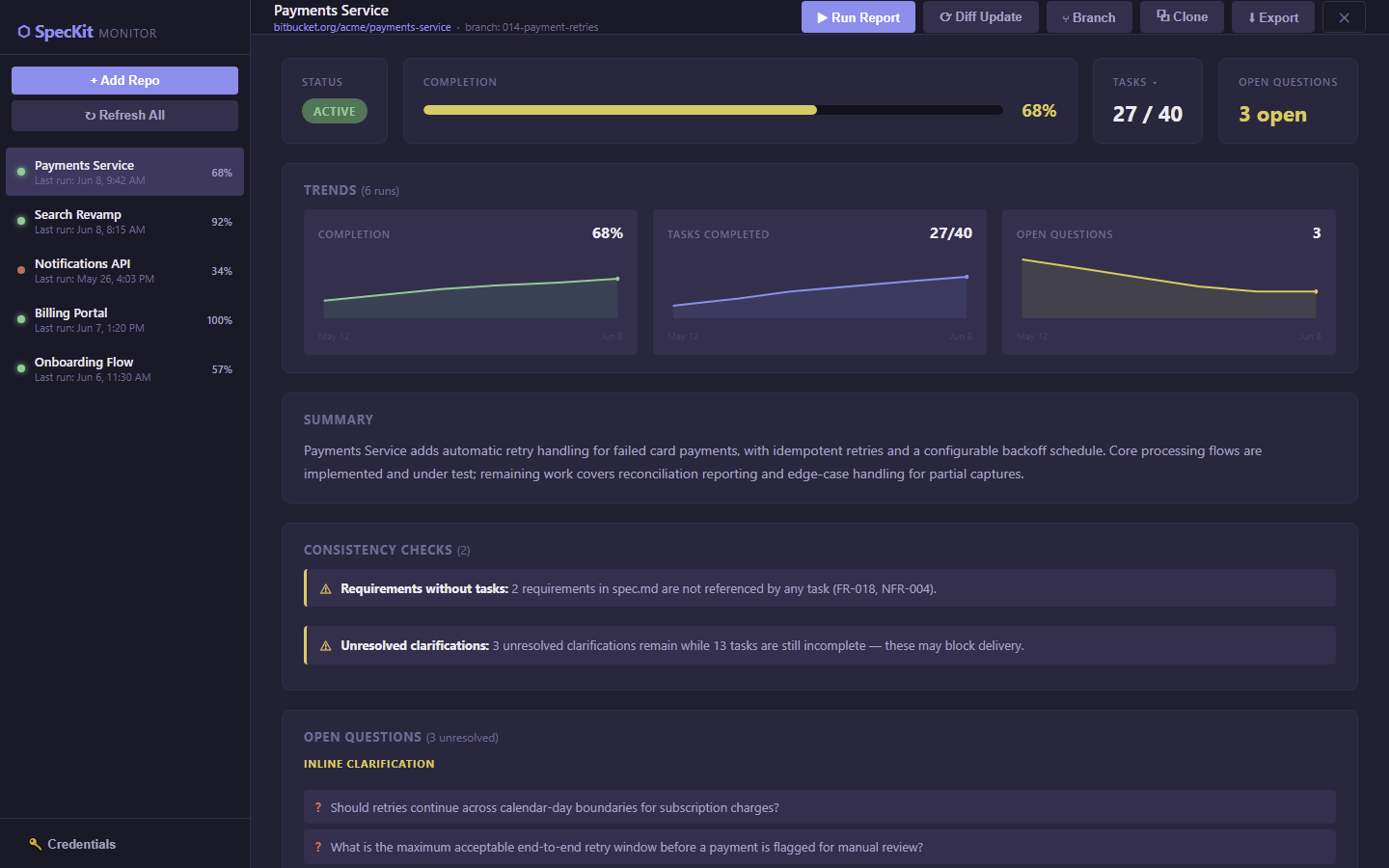
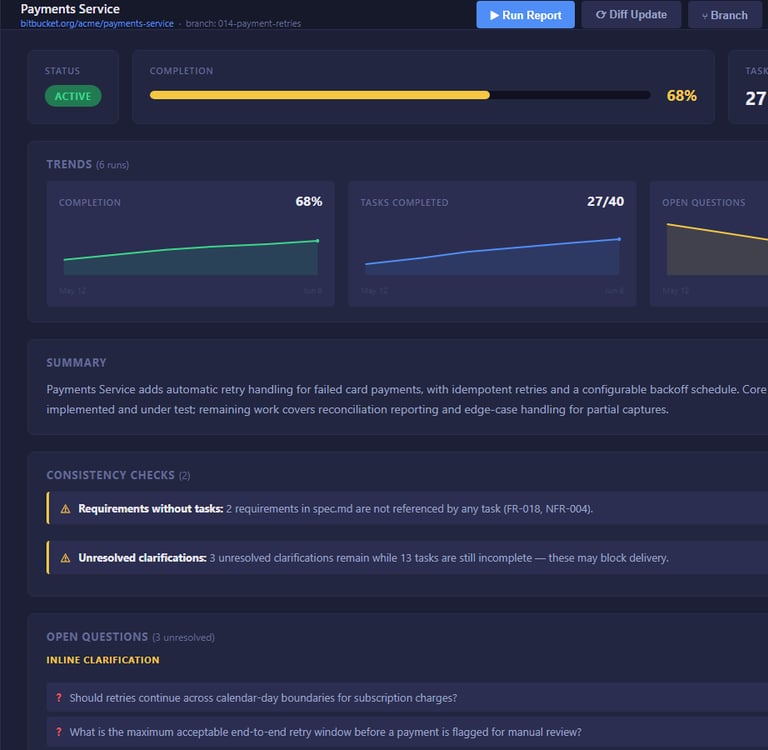
SpecKit Monitor turns your spec-driven repositories into a living product dashboard. Point it at any Bitbucket repo — Cloud or self-hosted Server / Data Center — pick a feature branch, and it reads the SpecKit artifacts straight from source: the constitution, spec.md, plan.md, tasks.md, and validation checklists. In seconds you get an honest, at-a-glance picture: completion percentage, task burn-down, stall detection, open questions, and governing principles — no status meetings required.
It's more than a status readout. SpecKit Monitor runs lightweight traceability checks that flag requirements with no tasks, tasks with no linked requirement, and unresolved [NEEDS CLARIFICATION] markers that could block a phase. A GitHub Models (gpt-4o) pass adds a plain-English summary, recent-activity digest, and constitution alignment concerns — so you catch drift between what was promised and what's being built. Every run is snapshotted into a time series, rendering trend charts for completion, tasks, and open questions, because direction matters more than a single number.
When it's time to report up, one click exports a polished Markdown or PDF report — simple or detailed — or fires a stakeholder digest across every watched project straight to a Slack or Teams webhook. Browse and search your whole repo catalog to add new projects, clone an entry to track a second branch, reorder by priority, and archive the ones that have shipped. It's the difference between checking on delivery and having delivery report to you.
Under the hood it's a portable Electron + TypeScript app with a shared core driving both a desktop GUI and a Commander-based CLI. A typed pipeline — Bitbucket REST fetchers → markdown parsers → analysis engine → renderer — keeps logic testable and front-ends thin, with secrets sealed at rest via Windows DPAPI. Charts are hand-rolled inline SVG (zero chart dependencies), context is token-budgeted to fit the model's limits, and the whole thing ships as a single self-contained build. Lean, fast, and built spec-first — exactly the way it expects you to work.